


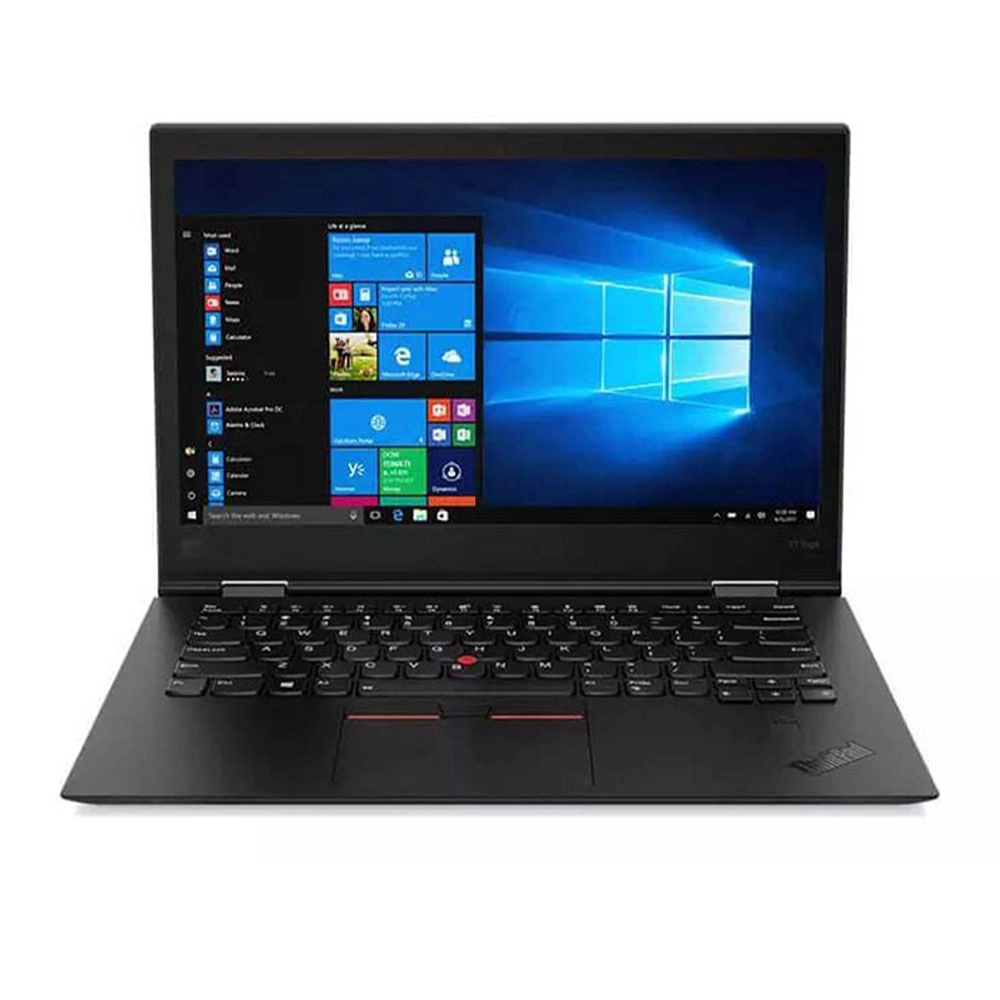


Lenovo Thinkpad X1 Yoga Gen 3 Laptop – Ci7-8th, 16GB RAM, 256 SSD Storage

| Brand and Model | Lenovo ThinkPad X1 Yoga Gen 3 |
|---|---|
| CPU model | Intel Core i7 8th Gen |
| Installed RAM memory size | 16GB LPDDR3-2133 |
| Graphics card description | Intel UHD Graphics 620 |
| Hard disk size | 256GB SSD NVMe |
| Screen size | 14 Inches |
| Colour | Grey |
800 AED 1,000 AED
Lenovo ThinkPad X1 Yoga Gen 3 Laptop – Core i7 8th Gen, 16GB RAM, 256GB SSD Storage
The Lenovo ThinkPad X1 Yoga Gen 3 laptop combines an eighth-generation Intel Core i7 processor, 16GB of LPDDR3 memory and a 256GB solid-state drive in a 14-inch convertible business system. Its design focuses on flexible interaction and established ThinkPad features rather than a conventional notebook layout alone. A rotating touchscreen, integrated pointing controls, optional active pen and a range of business connections make this generation suitable for users who move between document work, presentations and collaborative tasks. The Core i7 platform also provides four-core processing, giving the system the resources needed for a broad range of everyday professional applications.
Technical Specifications
| Component | Specification |
|---|---|
| Brand | Lenovo |
| Model | ThinkPad X1 Yoga Gen 3 |
| Processor | Intel Core i7 8th Generation |
| Processor Options | Core i7-8550U / Core i7-8650U |
| Cores / Threads | 4 cores / 8 threads |
| Maximum Turbo Frequency | Up to 4.0GHz or 4.2GHz, depending on CPU |
| Cache | 8MB |
| Memory | 16GB LPDDR3-2133 |
| Memory Upgrade | Soldered, not upgradeable |
| Storage | 256GB M.2 SSD |
| Storage Interface | SATA or PCIe NVMe, depending on drive configuration |
| Graphics | Integrated Intel UHD Graphics 620 |
| Display Size | 14 inches |
| Display Options | FHD, WQHD or HDR WQHD |
| Touchscreen | 10-point multi-touch |
| Hinge | 360-degree Yoga hinge |
| Pen Support | ThinkPad Pen Pro |
| Battery | Integrated 54Wh |
| Wireless | Wi-Fi 802.11ac |
| Bluetooth | Bluetooth 4.2 or 5.0, depending on module |
| Camera | HD 720p; optional IR camera |
| Audio | Stereo speakers with Dolby Audio Premium |
| Ports | 2× USB-A, 2× Thunderbolt 3 / USB-C, HDMI 1.4, microSD, audio combo |
| Security | TPM 2.0, fingerprint reader |
| Weight | Starting at approximately 1.4kg |
| Operating System | Windows 10 Pro on documented configurations |
Core i7 Performance in a Compact Business System
The ThinkPad X1 Yoga Gen 3 uses Intel’s eighth-generation Core i7 U-series processors. Lenovo lists two options: the Core i7-8550U and Core i7-8650U. Both feature four cores, eight threads and 8MB of cache, but their clock speeds differ.
The i7-8550U operates at a base frequency of 1.8GHz and reaches up to 4.0GHz with Turbo Boost. The i7-8650U starts at 1.9GHz and can reach 4.2GHz. This distinction matters when identifying the exact processor installed in an individual unit.
These processors are designed for mobile systems that balance performance with power consumption. They handle common professional workloads such as office applications, web-based platforms, spreadsheets, document editing and video communication. The four-core design also helps when several applications need processing resources at the same time.
For more demanding work, the processor can support moderate photo editing and other lighter creative applications. However, its integrated graphics and older mobile architecture place it below modern performance-oriented laptops for intensive rendering and advanced computational workloads.
Convertible Construction and Four Operating Modes
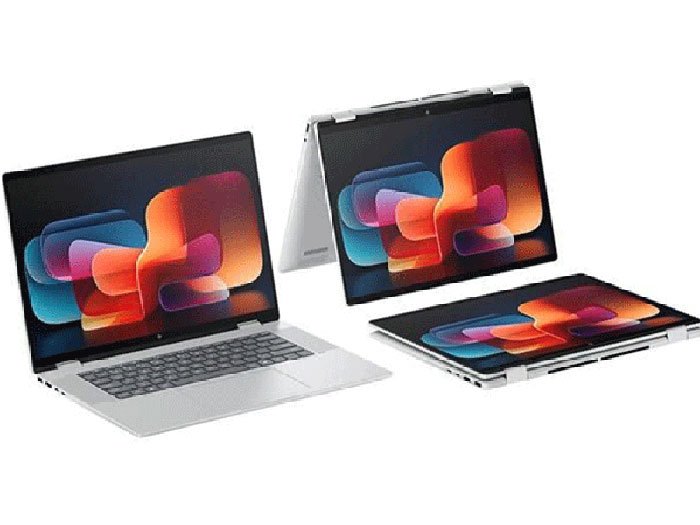
The defining characteristic of this ThinkPad generation is its Yoga hinge. The mechanism rotates through 360 degrees, allowing the display to move behind the keyboard and transform the system into different working positions.
- Laptop mode: The conventional configuration supports typing, office applications and extended document work.
- Tablet mode: Folding the keyboard behind the screen creates a touchscreen-focused setup for reading, browsing and handwritten input.
- Tent mode: The inverted V-shaped position is useful for shared viewing and presentations.
- Stand mode: The keyboard rests behind the display while the screen faces forward, making it suitable for video playback and touch interaction.
This arrangement gives the 14-inch system more flexibility than a fixed-hinge notebook. It can adapt to a desk, meeting room or presentation environment without requiring a separate tablet.
16GB LPDDR3 Memory
The installed 16GB LPDDR3-2133 memory provides the working space used by the processor and applications. This capacity supports multitasking across typical office software, browser sessions, email, communication tools and document workflows.
The memory configuration is particularly important because Lenovo solders the RAM directly to the system board. There are no conventional memory sockets, so the installed 16GB cannot be expanded through a later upgrade.
LPDDR3 is an older memory generation than the LPDDR4x and LPDDR5 standards used in newer notebooks. Nevertheless, 16GB remains a useful capacity for routine productivity and general business applications. Users who work with exceptionally large datasets or memory-intensive software should account for the fixed memory capacity.
256GB SSD Storage
The 256GB solid-state drive provides local space for the operating system, applications and working files. SSD technology reduces data access delays compared with traditional mechanical hard drives, helping the system start up and open applications more responsively.
The ThinkPad X1 Yoga Gen 3 platform supports M.2 storage in both SATA and PCIe NVMe forms. Therefore, the capacity alone does not identify the exact interface of the installed drive. The machine’s configuration or drive model is needed to establish whether a particular 256GB SSD uses SATA or PCIe NVMe.
For everyday office use, 256GB can accommodate productivity software and a moderate collection of documents. Large archives, video files and extensive project folders may require external storage or a network-based file system.
Integrated Intel UHD Graphics 620
The Core i7 configurations use integrated Intel UHD Graphics 620. This graphics processor is part of the CPU platform and shares system memory rather than using its own dedicated video memory.
It handles the internal touchscreen, desktop interface, video playback and standard graphical tasks. The laptop can also connect external displays through its HDMI and Thunderbolt 3 ports. Lenovo’s platform documentation specifies support for up to three independent displays under supported connection arrangements.
The UHD Graphics 620 is designed for everyday visual workloads rather than high-performance graphics processing. It can support standard office visuals and light image editing, but demanding 3D design, advanced video production and modern graphics-intensive games are outside its primary role.
14-Inch Display Options
Lenovo offered the X1 Yoga Gen 3 with several 14-inch display configurations. These include Full HD at 1920 × 1080, WQHD at 2560 × 1440 and an HDR WQHD option with Dolby Vision.
The Full HD panel provides a standard resolution for office documents and general applications. WQHD increases image detail, while the HDR version adds a higher specified brightness level and wider colour coverage.
The documented HDR WQHD configuration reaches 500 nits and supports 100% colour gamut coverage. The other listed panel options have different brightness and colour specifications. All versions use a touchscreen interface with support for ten-finger gestures, anti-reflection treatment and an anti-smudge surface.
This range of panels gives the platform different display characteristics across configurations. The exact resolution and visual properties depend on the installed screen rather than the processor or memory capacity.
ThinkPad Pen Pro for Direct Input
The touchscreen works with Lenovo’s ThinkPad Pen Pro, an active stylus designed for direct interaction with the display. The pen is rechargeable and can be stored inside the laptop on configurations equipped with the integrated pen holder.
It provides a practical input method for writing notes, marking up documents, sketching diagrams and navigating compatible applications. In tablet mode, the pen can make the system more convenient for tasks that involve handwriting or precise screen selection.
The pen is listed as an optional feature in Lenovo’s platform specifications. Its presence should therefore be checked against the exact machine configuration rather than assumed for every X1 Yoga Gen 3.
Battery Capacity and Charging
A 54Wh integrated lithium-ion battery supplies power to the system. Lenovo specifies Rapid Charge support, which can recharge the battery to approximately 80% in one hour when using a compatible 65W USB-C adapter.
Actual battery runtime depends on the display panel, brightness, wireless connections, application load and battery condition. Lenovo’s published MobileMark 2014 result reaches up to 15.4 hours under its test conditions, but this figure should not be treated as a guaranteed runtime for every configuration or an older individual device.
The convertible chassis starts at approximately 1.4kg. Its 14-inch format and relatively compact dimensions make it suitable for carrying between work locations, while the folding screen provides additional flexibility when a desk or conventional laptop position is not available.
Thunderbolt 3 and Physical Connections
Connectivity is an important part of the X1 Yoga Gen 3’s business-oriented design. Two USB-C ports support Thunderbolt 3, Power Delivery, DisplayPort and data transfer. These connections can link compatible docking stations, external storage devices and monitors.
The system also includes two USB 3.1 Gen 1 Type-A ports, one of which supports Always On functionality. An HDMI 1.4 port provides a direct connection to compatible displays and projectors. A microSD card reader and a combined headphone and microphone jack complete the main selection.
Selected configurations also support mobile broadband through an optional 4G LTE-A module and Nano-SIM slot. Wireless networking uses an 802.11ac Wi-Fi module, while Bluetooth 4.2 or Bluetooth 5.0 depends on the installed wireless card.
Keyboard, TrackPoint and Security Features
The ThinkPad keyboard provides a familiar six-row layout with spill-resistant construction and LED backlighting. Its TrackPoint pointing device allows cursor control from the keyboard area, while the multi-touch clickpad offers another navigation method.
For business security, the platform includes a discrete TPM 2.0 security chip and a touch-style fingerprint reader integrated into the palm-rest area. Users can also configure power-on, hard-drive and supervisor passwords. Selected models include an infrared camera alongside the standard HD camera, adding facial authentication support where the camera configuration permits it.
The chassis uses a carbon-fibre and glass-fibre hybrid display cover with a magnesium-PPS hybrid bottom. Lenovo also lists MIL-STD-810G testing for the platform, reflecting its business-oriented construction requirements.
Advantages and Limitations
Key advantages
- Eighth-generation Core i7 processors provide four cores and eight threads.
- 16GB of LPDDR3 memory supports everyday multitasking.
- The 360-degree hinge offers four operating modes.
- The 14-inch touchscreen supports direct interaction and compatible pen input.
- Two Thunderbolt 3 ports support high-speed data, charging and display connections.
- Fingerprint authentication and TPM 2.0 provide business-focused security features.
Important limitations
- The 16GB memory is soldered and cannot be upgraded.
- Intel UHD Graphics 620 is not designed for demanding 3D workloads.
- The 256GB storage capacity may be restrictive for large media collections.
- Display resolution and SSD interface vary by configuration.
- The eighth-generation processor and Thunderbolt 3 platform are older than those in current-generation notebooks.
Final Overview
The Lenovo ThinkPad X1 Yoga Gen 3 combines an eighth-generation Core i7 processor, 16GB of memory and 256GB of SSD storage with a versatile 14-inch touchscreen. Its 360-degree hinge and ThinkPad Pen Pro support different ways of working, while the keyboard, TrackPoint, Thunderbolt 3 connectivity and built-in security features retain the practical character of the ThinkPad family. It brings together convertible functionality and established business computing features in a compact notebook format.
| Brand | |
|---|---|
| Model | Lenovo ThinkPad X1 Yoga Gen 3 |
| Processor | |
| RAM | |
| Storage | |
| Graphics | |
| Screen Size | |
| Camera | Integrated Camera |
| Color | |
| Keyboard | Backlit Keyboard, US-English |
| Operating System | Window 10 Pro |
| Condition | Used-Excellent (Fully Tested) |
| Battery | |
| Weight | 1.4 kg |
| Warranty | 3 Months |
Based on 0 reviews
Only logged in customers who have purchased this product may leave a review.
Related products
-
Surface Pro, Tablet and Detachable
Microsoft Surface Pro 6 Core i5-8250U 8GB 256GB
Surface Pro, Tablet and DetachableMicrosoft Surface Pro 6 Core i5-8250U 8GB 256GB
Brand and Model Microsoft Surface Pro 6 CPU model Intel Core i5-8250U Installed RAM memory size 8GB LPDDR3 Graphics card description Intel UHD 620 Hard disk size 256GB SSD Nvme Screen size 13.1Inches Full HD Colour Silver SKU: n/a -
Surface Book, Tablet and Detachable
Surface Book3 Core i7-10th Gen 32GB RAM 512GB SSD 4GB Graphics
-14% Surface Book, Tablet and Detachable
Surface Book3 Core i7-10th Gen 32GB RAM 512GB SSD 4GB Graphics
Surface Book, Tablet and DetachableSurface Book3 Core i7-10th Gen 32GB RAM 512GB SSD 4GB Graphics
Brand and Model Microsoft Surface Book 3 CPU model Intel Core i7-1065G7 Installed RAM memory size 32GB DDR4 Graphics card description 4GB Nvidia GTX 1650 Max-Q Hard disk size 512GB SSD Nvme Screen size 13.5 Inches Full HD Color Silver 
What is Tested Working?
This Renewed product is tested and certified to … more
How to deliver ?All delivery and payment options… more 
Warranty , Term and Condition?
In case you got problem and want to return … more
Order it easy ? Oder this item from whats-app Now.. more SKU: n/a -
Surface Book, Tablet and Detachable
Surface Book2 i5 8th Laptop Ram 8GB Storage 256GB SSD 13.5″ Detachable Touchscreen Win 11 Silver
-10% Surface Book, Tablet and Detachable
Surface Book2 i5 8th Laptop Ram 8GB Storage 256GB SSD 13.5″ Detachable Touchscreen Win 11 Silver
Surface Book, Tablet and DetachableSurface Book2 i5 8th Laptop Ram 8GB Storage 256GB SSD 13.5″ Detachable Touchscreen Win 11 Silver
Brand and Model Microsoft Surface Book 2 CPU model Intel Core i5-8200U Installed RAM memory size 8GB DDR4 Graphics card description Intel HD Graphic 620 Hard disk size 256GB SSD Nvme Screen size 13.5 Inches Full HD Color Silver What is Tested Working?
This Renewed product is tested and certified to … moreHow to deliver ?All delivery and payment options… more Warranty , Term and Condition?
In case you got problem and want to return … moreOrder it easy ? Oder this item from whats-app Now.. more SKU: n/a -
Surface Book, Tablet and Detachable
Microsoft Surface Book-2 Core i7-8th | 16GB 512GB 2GB Graphics
-13% Surface Book, Tablet and Detachable
Microsoft Surface Book-2 Core i7-8th | 16GB 512GB 2GB Graphics
Surface Book, Tablet and DetachableMicrosoft Surface Book-2 Core i7-8th | 16GB 512GB 2GB Graphics
Brand and Model Microsoft Surface Book 2</strong> CPU model Intel Core i7-8th Installed RAM memory size 16GB DDR4 Graphics card description d=”3145″>2GB Dedicated Graphic ss=”a-span3″ role=”presentation”><strong>Hard disk size</td> class=”a-span9″ role=”presentation”>512GB SSD Nvme Screen size <span class=”a-size-base po-break-word”>12.3 Inches Full HD Colour</span></span> =”a-span9″ role=”presentation”>Silver SKU: Su70149
There are no reviews yet.